

At Brightmind Partners we look for founders with lived experiences that drive them to take on large, complex problems. Onit Security founder, Ofer Amitai , experienced the significant consequences of an unmanageable vulnerability backlog that resulted in the compromise of his prior company, Portnox. With the weight of that experience, the Onit team aggressively pursued a new approach to exposure management, utilizing AI to unify true business context with risk signals across the enterprise and close the gap at unprecedented speed and scale.
A Challenge Built for the AI-era
Traditional vulnerability and exposure management has been focused on silos, utilizing scanners to identify risk within domains. In talking with operators, we saw a significant trend towards homegrown solutions to tackle the unification challenge. Despite the presence of tools in RBVM and UVM over the past half decade, we found considerable levels of supplementation to engineer a business process compatible with the needs of the enterprises. With enormous tool sprawl and increasing IT complexity. No two customer environments truly look the same. Efforts to manage the holistic vulnerability pipeline historically have been nearly impossible due to three primary factors 1) limited business context regarding the underlying assets 2) the ability to define prioritization consistently 3) the ability to take action seamlessly without generating unintended consequences.
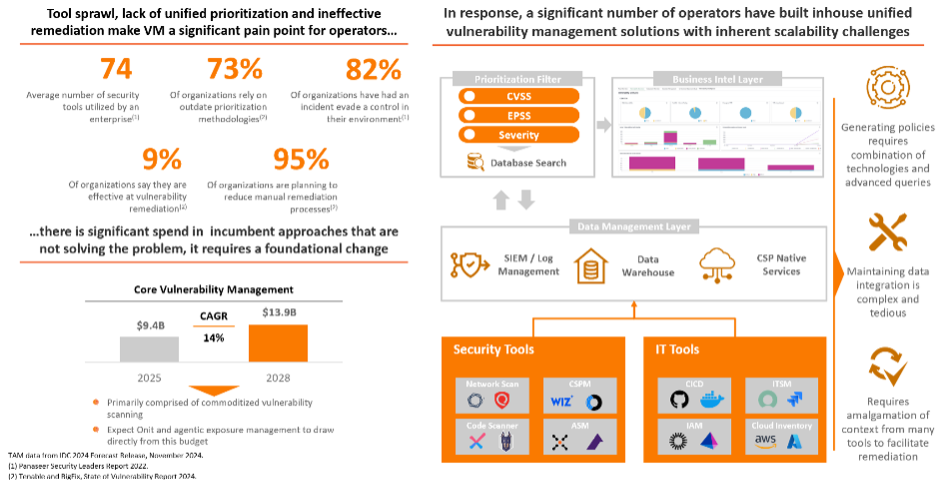
AI has fundamentally shifted this paradigm, enabling business context and reasoning to drive each decision in the vulnerability management lifecycle at machine speed.
The Onit platform enables customers to embed their feedback into the engine, ensuring that the actions that are driven by the platform align to their unique concept of risk. This is a decision-based architecture, an AI-native approach that allows operators to autonomously respond to threats as they emerge, closing the gaps as they open. With adversaries driving breakout times in as little as 27 seconds using AI, it is critical that we build the foundation for autonomous vulnerability management today.
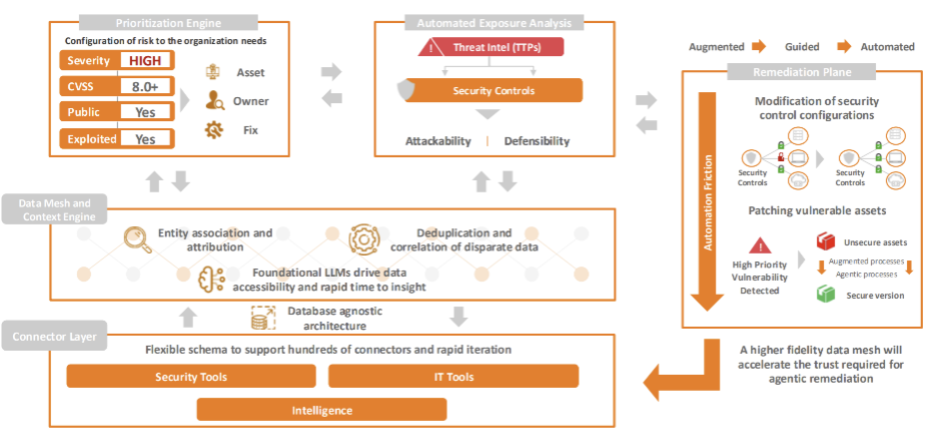
Beyond the risk profile, there are also significant productivity gains to be realized by automation in this domain, and we expect that forward-looking operators will heavily value the time and focus their IT and engineering teams recover as a result.
We could not be happier to partner with Elad Ben Meir , Ofer Amitai , Tom Winter and the Onit Security team! Their relentless desire to reshape this market motivated us from day one to be a part of their journey.
Let's Secure Tomorrow, Together.
We're always looking for the next generation of cybersecurity innovators. Reach out to our team to start the conversation.

Other Articles
Why We Invested in Empirical: Building Global and Local AI Models for Cybersecurity
Empirical Security is building domain-specific AI models for cybersecurity, founded on the belief that the next generation of security is not a faster scanner or a better dashboard but a security intelligence layer combining global threat intelligence with local, customer-specific environment context. The platform operates through two concentric layers: a Global AI Model, a continuously updating probabilistic scoring model trained on years of curated, globally-pooled data with scores recomputing daily, and per-tenant Local Models, custom enterprise-specific cybersecurity domain models trained on each customer's own telemetry, assets, and controls, which constitute the company's real moat. The first applied use case is exploitation prioritization, answering not just what is vulnerable but what is exploitable in a specific environment right now, extending beyond CVE-based scoring into cloud misconfigurations and application security findings. The founding team invented risk-based vulnerability management and EPSS itself: CTO Michael Roytman is an original EPSS author, Chief Data Scientist Jay Jacobs co-chairs the EPSS Special Interest Group at FIRST, and Ed Bellis co-founded Kenna Security, serving as CTO through Cisco's 2021 acquisition after six years as CISO of Orbitz. EPSS is now integrated into over 120 security platforms and was explicitly endorsed by Anthropic in its April 2026 guidance for AI-accelerated vulnerability discovery, the first time a major LLM provider has backed a purpose-built cybersecurity prioritization model. Brightmind Partners is leading Empirical's $25 million Series A alongside Costanoa Ventures, Hyde Park Angels, and angel investors from across the security ecosystem, bringing total funding to $37 million.
Pi: Building Zero Recurrence Code Security for the AI CodeGen Era
Pi Security is defining a new category, Zero Recurrence Code Security, built on the premise that the industry no longer has a vulnerability discovery problem but a vulnerability recurrence problem. Rather than generating more findings, Pi learns how an organization builds, breaks, fixes, and secures software, then turns that institutional security knowledge into preventative guardrails enforced across the software development lifecycle at design time, IDE time, and pull request time. The platform ingests context from prior incidents, tickets, pull requests, repositories, architecture decisions, and developer workflows to drive root cause analysis, variant discovery, contextual remediation, and ownership mapping, becoming a living security intelligence layer for developers, AI coding agents, and security teams. Founded by Guy Arazi, an offensive security operator and former CISO with roots at Palo Alto Networks and Microsoft, and Yonatan Ramon, who built safety-critical systems at Tesla, Pi raised a $35 million Series A alongside Third Point Ventures and angels including George Kurtz, Yevgeny Dibrov, and Nadir Izrael. Brightmind led Pi's Seed round in early 2025 and is continuing its support through the Series A.