
The Brightmind Partners team has a long history with the SIEM category. Whether helping to build one of the fastest growing SIEM platforms at CrowdStrike or managing SIEM operations at Fortune 50 scale, our perspectives were clearly aligned on two major areas 1) AI would fundamentally change the detection and investigation process 2) the underlying data architecture needed to be more dynamic and adaptive. Most of the operators we spoke to agreed on the need and recognized shortfalls of incumbent approaches, but we heard a lot of the same opinions - SIEM is “hard” and it’s “too big to fail”. This sentiment still gets us excited when we think about the Artemis opportunity. We believe that in the AI era, inertia is no longer a moat – enterprise grade products can be built by the right teams in quarters rather than years and AI-assisted adversaries move faster than incumbents.
Adaptive Protection, a Bold Approach to Understand and Defend the Enterprise
The best teams we have worked with tune down the volume on inertia, trusting their lived experiences, knowing that they can build solutions capable of delivering better outcomes. Shachar Hirshberg and Dan Shiebler exemplify this mindset, with immense experience at the confluence of SIEM and AI from their former leadership roles at AWS and Abnormal Security. Together, they set out to build a new approach to security operations: adaptive protection. Adaptive protection is built on a straightforward premise: enormous volumes of data across enterprises go underutilized and the context from that data needs to be deeply embedded in an autonomous detection lifecycle. With adaptive protection, the detection, investigation and response is automated with the full context of the enterprise environment, eliminating costly false positives and evaluating threats as comprehensive attack stories. The speed of AI-assisted adversaries is rendering the traditional detection engineering and investigation process obsolete, operators need adaptive detection that understands the threat landscape, their infrastructure and business context with the ability to federate or centralize the underlying data. This is no easy task; it is a broad vision the SIEM space has attempted to build for over a decade. It took the Artemis team six months.
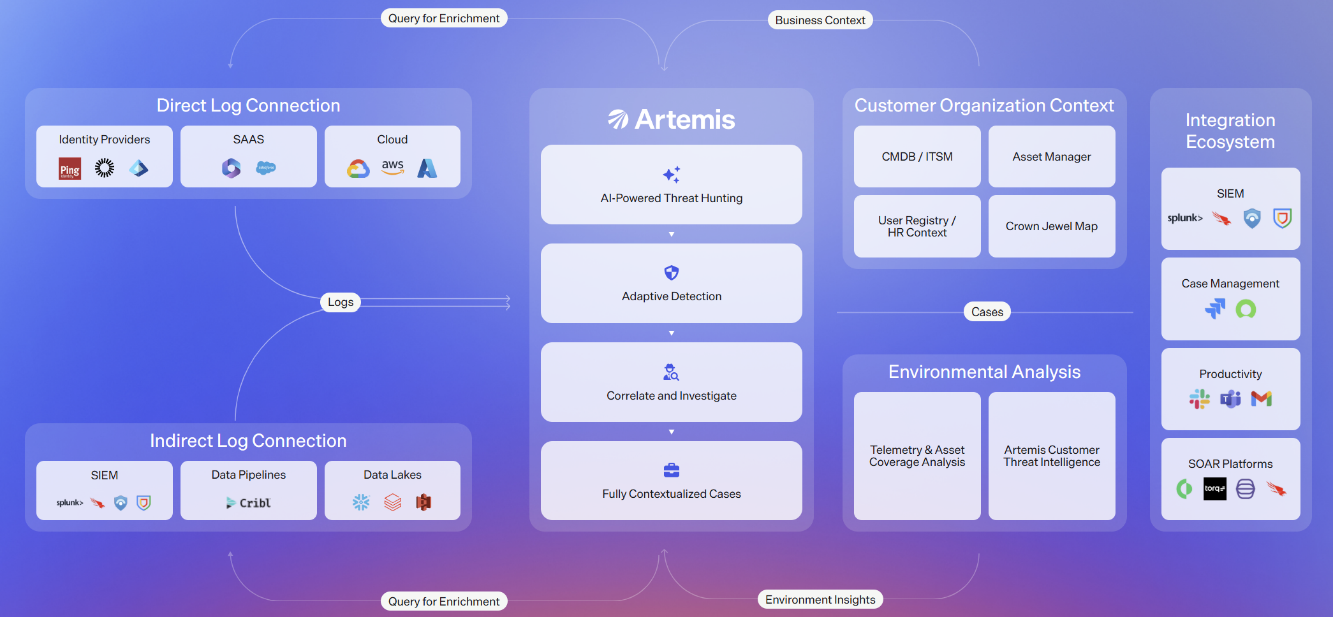
Artemis’ AI-Native Protection Platform
An Architecture that does not Rely on Data Gravity
The SIEM market has been built on a foundation of ingest and retention economics, singularly focused on driving as much data as possible to a centralized plane. However, data management strategies have become increasingly fragmented with data warehouses, cloud datastores and first party security vendors all providing their own unique and effective value propositions. Indexing to a centralized security data management strategy may be right for some and wrong for others. Whether running adaptive protection over multiple SIEMs, datastores or centralizing on Artemis’ storage, Artemis built their platform for complete flexibility, delivering the outcomes without the lock-in.
Beyond product excellence, Shachar and Dan have built a culture of customer obsession that blurs the lines between product and service, deeply aligning themselves as a trusted partner. We are incredibly proud to have worked with Artemis from day one. This is just the beginning – onward and upward!
Let's Secure Tomorrow, Together.
We're always looking for the next generation of cybersecurity innovators. Reach out to our team to start the conversation.

Other Articles
Why We Invested in Empirical: Building Global and Local AI Models for Cybersecurity
Empirical Security is building domain-specific AI models for cybersecurity, founded on the belief that the next generation of security is not a faster scanner or a better dashboard but a security intelligence layer combining global threat intelligence with local, customer-specific environment context. The platform operates through two concentric layers: a Global AI Model, a continuously updating probabilistic scoring model trained on years of curated, globally-pooled data with scores recomputing daily, and per-tenant Local Models, custom enterprise-specific cybersecurity domain models trained on each customer's own telemetry, assets, and controls, which constitute the company's real moat. The first applied use case is exploitation prioritization, answering not just what is vulnerable but what is exploitable in a specific environment right now, extending beyond CVE-based scoring into cloud misconfigurations and application security findings. The founding team invented risk-based vulnerability management and EPSS itself: CTO Michael Roytman is an original EPSS author, Chief Data Scientist Jay Jacobs co-chairs the EPSS Special Interest Group at FIRST, and Ed Bellis co-founded Kenna Security, serving as CTO through Cisco's 2021 acquisition after six years as CISO of Orbitz. EPSS is now integrated into over 120 security platforms and was explicitly endorsed by Anthropic in its April 2026 guidance for AI-accelerated vulnerability discovery, the first time a major LLM provider has backed a purpose-built cybersecurity prioritization model. Brightmind Partners is leading Empirical's $25 million Series A alongside Costanoa Ventures, Hyde Park Angels, and angel investors from across the security ecosystem, bringing total funding to $37 million.
Pi: Building Zero Recurrence Code Security for the AI CodeGen Era
Pi Security is defining a new category, Zero Recurrence Code Security, built on the premise that the industry no longer has a vulnerability discovery problem but a vulnerability recurrence problem. Rather than generating more findings, Pi learns how an organization builds, breaks, fixes, and secures software, then turns that institutional security knowledge into preventative guardrails enforced across the software development lifecycle at design time, IDE time, and pull request time. The platform ingests context from prior incidents, tickets, pull requests, repositories, architecture decisions, and developer workflows to drive root cause analysis, variant discovery, contextual remediation, and ownership mapping, becoming a living security intelligence layer for developers, AI coding agents, and security teams. Founded by Guy Arazi, an offensive security operator and former CISO with roots at Palo Alto Networks and Microsoft, and Yonatan Ramon, who built safety-critical systems at Tesla, Pi raised a $35 million Series A alongside Third Point Ventures and angels including George Kurtz, Yevgeny Dibrov, and Nadir Izrael. Brightmind led Pi's Seed round in early 2025 and is continuing its support through the Series A.