
A Continuous Identity Approach: Stopping the Threats of Tomorrow, Today
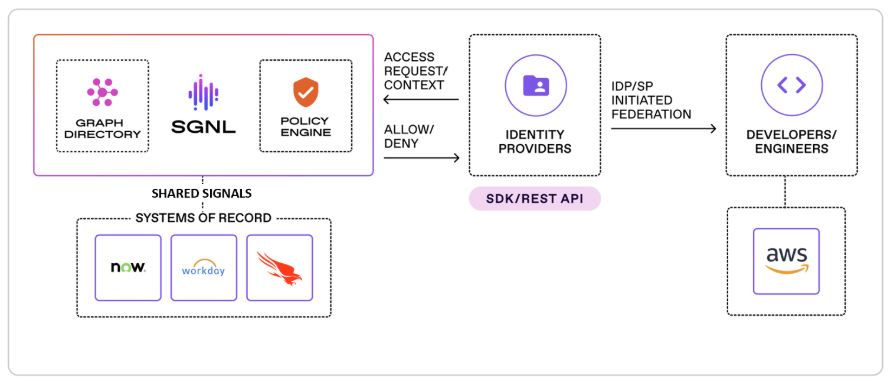
The level of activity in identity over the course of the last twelve months has been nothing less than transformative, but not all strategies are created equal. While identity is a pillar of enterprise security strategies, there has historically been a considerable disconnect between SecOps and access management. SGNL was built from the ground up to address this gap, to connect critical data into the context of access decisions in real time, unlocking the full potential of identity to drive security outcomes. Whether at the point of an access request or in the midst of a session, SGNL continuously adapts and eliminates risks as it emerges.
Example of SGNL enabling dynamic access to critical cloud infrastructure.
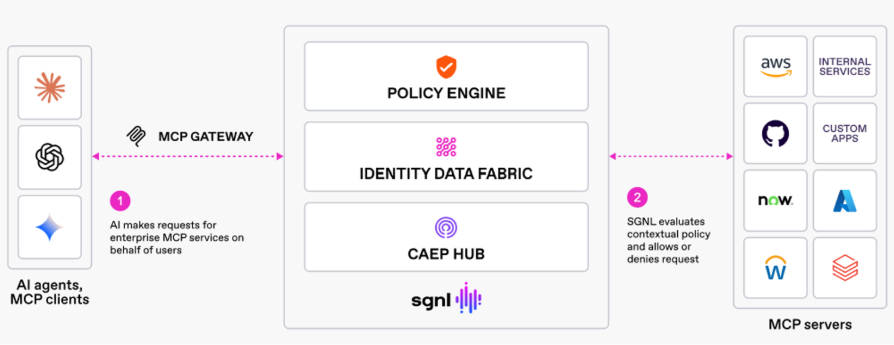
The rapid adoption of AI is pushing the traditional static approaches utilized by PAM vendors to their breaking point. Enterprises need to contextualize access decisions at unprecedented speed to safely unlock the productivity gains of AI agents. With their dynamic architecture, SGNL enables organizations to deploy and manage agents without compromising their zero trust standards.
Example of SGNL managing access policies to sensitive data between MCP clients and servers.
An Identity Security Platform Emerges
CrowdStrike stops breaches, an always on, continuous mission. An analytics powerhouse, CrowdStrike processes more than a trillion events a day with sub second latency – their platform has never been static. CrowdStrike’s first act in identity began with threat detection, deploying sensors to domain controllers to help detect and respond to threats against active directory. The second act came in the form of cloud-based identity visibility, posture, and detections. Between the two, CrowdStrike is the most complete identity threat detection offering on the planet by a strong margin. However, identity threat detection is a small component of the overall identity stack, albeit a highly differentiated offering that identity native vendors have struggled with, and without a differentiated offering in access management CrowdStrike’s reach was limited.
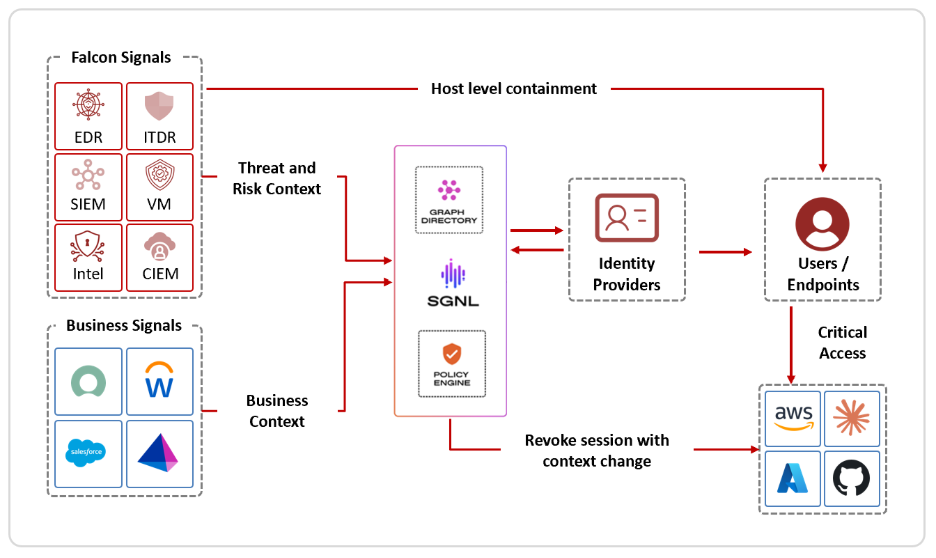
The integration of SGNL enables CrowdStrike to merge detection and access management within a consolidated platform delivering threat driven, continuous identity. This new paradigm embeds security analytics into the identity stack to enable zero trust purpose built for the agentic era.
Threat driven continuous identity enables dynamic access and enforcement over critical data
Congratulations to Scott Kriz , Erik Gustavson and the SGNL team – you are truly a team built for this mission. Brightmind is extremely proud to have been a part of your journey. Together with CrowdStrike, we know you will transform identity security.
Link to the press release: https://ir.crowdstrike.com/news-releases/news-release-details/crowdstrike-acquire-sgnl-transform-identity-security-ai-era
Let's Secure Tomorrow, Together.
We're always looking for the next generation of cybersecurity innovators. Reach out to our team to start the conversation.

Other Articles
Why We Invested in Empirical: Building Global and Local AI Models for Cybersecurity
Empirical Security is building domain-specific AI models for cybersecurity, founded on the belief that the next generation of security is not a faster scanner or a better dashboard but a security intelligence layer combining global threat intelligence with local, customer-specific environment context. The platform operates through two concentric layers: a Global AI Model, a continuously updating probabilistic scoring model trained on years of curated, globally-pooled data with scores recomputing daily, and per-tenant Local Models, custom enterprise-specific cybersecurity domain models trained on each customer's own telemetry, assets, and controls, which constitute the company's real moat. The first applied use case is exploitation prioritization, answering not just what is vulnerable but what is exploitable in a specific environment right now, extending beyond CVE-based scoring into cloud misconfigurations and application security findings. The founding team invented risk-based vulnerability management and EPSS itself: CTO Michael Roytman is an original EPSS author, Chief Data Scientist Jay Jacobs co-chairs the EPSS Special Interest Group at FIRST, and Ed Bellis co-founded Kenna Security, serving as CTO through Cisco's 2021 acquisition after six years as CISO of Orbitz. EPSS is now integrated into over 120 security platforms and was explicitly endorsed by Anthropic in its April 2026 guidance for AI-accelerated vulnerability discovery, the first time a major LLM provider has backed a purpose-built cybersecurity prioritization model. Brightmind Partners is leading Empirical's $25 million Series A alongside Costanoa Ventures, Hyde Park Angels, and angel investors from across the security ecosystem, bringing total funding to $37 million.
Pi: Building Zero Recurrence Code Security for the AI CodeGen Era
Pi Security is defining a new category, Zero Recurrence Code Security, built on the premise that the industry no longer has a vulnerability discovery problem but a vulnerability recurrence problem. Rather than generating more findings, Pi learns how an organization builds, breaks, fixes, and secures software, then turns that institutional security knowledge into preventative guardrails enforced across the software development lifecycle at design time, IDE time, and pull request time. The platform ingests context from prior incidents, tickets, pull requests, repositories, architecture decisions, and developer workflows to drive root cause analysis, variant discovery, contextual remediation, and ownership mapping, becoming a living security intelligence layer for developers, AI coding agents, and security teams. Founded by Guy Arazi, an offensive security operator and former CISO with roots at Palo Alto Networks and Microsoft, and Yonatan Ramon, who built safety-critical systems at Tesla, Pi raised a $35 million Series A alongside Third Point Ventures and angels including George Kurtz, Yevgeny Dibrov, and Nadir Izrael. Brightmind led Pi's Seed round in early 2025 and is continuing its support through the Series A.