Reconstructing Modern Application Security
This article describes how the modern application security Rube Goldberg machine was created, why every component seemed reasonable at the time, and what the alternative looks like now that it's finally buildable.
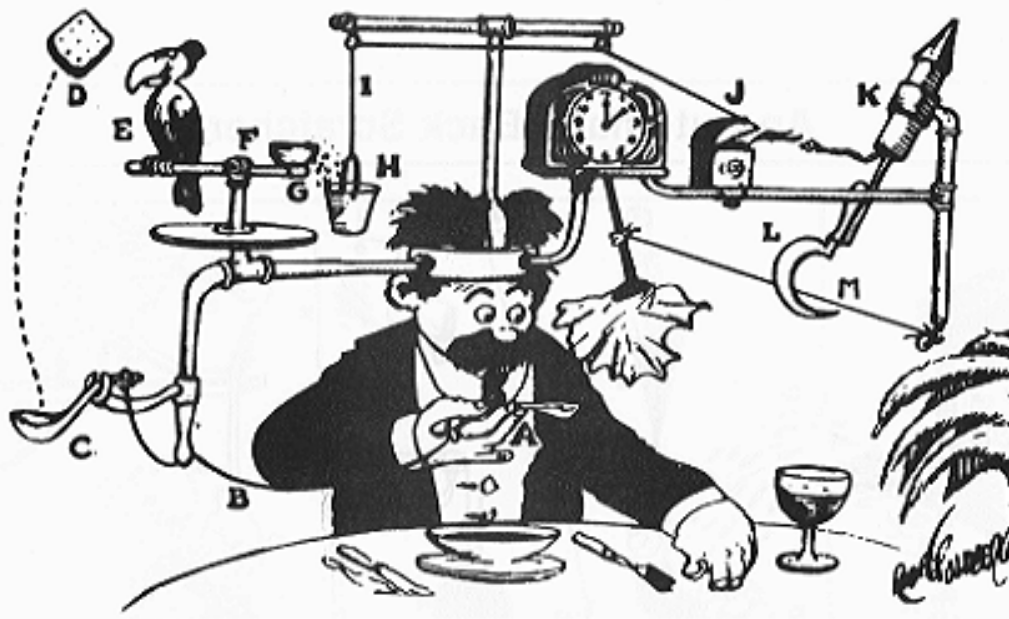
Many of us have worked in this field long enough to have watched application security pass through several distinct eras, and in many cases have been fortunate enough to participate in all of them. Each era produced better tools than the last, and each era left the underlying problem where it found it, because what we measured was never what was hurting us. What we have built over twenty-five years are not application security programs in any coherent sense. They are Rube Goldberg machines: elaborate assemblies of individually sensible components, each triggered by the output of the last, collectively producing enormous motion and surprisingly little security. This paper describes how that machine got built, why every component seemed reasonable at the time, and what the alternative looks like now that it's finally buildable.
The Stone Age
Start at the beginning, in the early 2000s, when we ran tools like Fortify, Watchfire, and WebScarab and the entire practice was batch-based and, in many cases, manual. Developers wrapped their builds with tooling we wrote ourselves, uploaded the artifacts to various analysis platforms, and waited an indeterminate amount of time for a report. Somebody then sat down and read it, and once the application was built, we exercised it by hand against the running system. That was slow and awkward by any modern standard, and entirely appropriate to its moment. An application in that era was a monolith sitting in a known repository, with a deployment you could point at and a release cadence measured in weeks, and the vulnerabilities that mattered were the ones a parser could recognize on sight. The early OWASP lists were an attempt to organize that search, to give a fragmented industry a shared vocabulary for what everyone was looking for, and in those days the vocabulary and the tooling lined up: the things on the list were things a pattern matcher finds. That alignment between what we were looking for and what we could look at is rarer in this industry than most people appreciate, and we haven't enjoyed it since.
When a Pipeline isn’t a Pipeline
Then continuous integration arrived, and scanning became a build stage, so we broke builds, installed checkpoints, and moved findings much closer to the keyboard. We called this shifting left, and it was a genuine improvement, but it did nothing about the dependency at the center of the arrangement: a scan only ever covers an application somebody remembered to onboard. The backlog persisted accordingly, and red teams and external black box testers kept delivering findings we had never seen before, for reasons that were almost always administrative rather than technical. The application had not been onboarded, or it had not been modernized, or no one had inventoried it in the first place.
It is worth pausing on the word pipeline, because we adopted it during this period and it has done us a quiet disservice ever since. A pipeline implies a spine, which is to say a single organizing structure that every stage is oriented around and accountable to, with inputs and outputs that mean the same thing at every point along its length. What we built was a sequence of independent checks that happened to execute in the same job. They shared a build, and nothing else. They did not share a model of the application, a definition of severity, a notion of what the application was permitted to do, or any memory of what had been decided about it last quarter. We called that a pipeline because the stages ran in order, much like one might call a Rube Goldberg machine a logical solution to a problem.
Adequate to Obligation…
We responded rationally to the growing scope, starting with the crown jewels and working outward until we had a program respectable enough to satisfy the compliance obligations the organization had agreed to carry. In that we created yet another problem, the program was adequate to the obligation, and it was not adequate to the risk. Those are two different standards; different people measure them for different reasons, and the gap between them is where the last fifteen years of this industry have quietly lived. Once an organization has a program that satisfies its auditors, the pressure to reorganize that program around actual risk drops to nearly zero, and every subsequent investment tends to reinforce the shape that has already passed.
The Buying Era
Then came the buying era, when we acquired static analysis, composition analysis, dynamic analysis, secrets detection, infrastructure-as-code scanning, container scanning, etc., each of which was individually defensible but produced an independent queue. We quickly realized that a finding is inexpensive to generate and expensive to resolve, and every tool we purchased lowered the cost of producing findings, but none lowered the cost of deciding what to do about them. We industrialized the cheap half of the problem with remarkable efficiency and left the expensive half to a group of application security engineers already working well past capacity.
Worse, each acquisition arrived with its own worldview, expressed through its own console, its own policy language, and a severity scale calibrated to its vendor’s incentives. None of them agreed on anything of consequence, including what counts as an application. Two tools would report the same underlying weakness under different names and different severities, and reconciling them became a job left for teams tasked with translating application security risk into business terms. Each one also brought an integration surface that somebody had to maintain, which is why the operational tail of a security tool is almost always larger than its license cost, and we have never learned to price that part of the process properly.
The Machine
So, we bolted on another layer, this one built to manage the layers we had already bolted on, and that is how threat exposure management programs came to exist. Their entire purpose was to deduplicate and prioritize the output of the tools we had purchased to find problems. That sentence deserves to be read twice, because it marks the precise moment the machine began feeding on itself. Each new contraption was created to catch the marble dropped by the one before it, and each was marketed as secure from the start. Each bolt-on moved the needle a little and added more moving parts than it removed, until the complexity defeated the purpose the machine was built for, consuming almost all of the attention that should have gone to the thing we claimed to want in the first place… helping developers write secure code.
Look at the anatomy of the machine as it exists in a typical enterprise today. A commit triggers between at least two and five independent analyses, each of which writes to its own store and maybe creates a scorecard for the build. A correlation layer ingests those stores and attempts to determine which findings describe the same defect. A prioritization layer applies a scoring model… usually incorporating exploitability data from a third source and asset criticality from a fourth… both of which are probably stale or nonexistent. A ticketing integration creates work items in a system the developer already resents. A reporting layer aggregates all of it into a metric that is presented monthly to an executive who reasonably asks why the number is not going down. No component in that chain knows what the application is supposed to do or who is allowed to do it, so none of them can say what actually constitutes a priority. The machine is elaborate and expensive, and its most reliable output is job security.
Paying Per Finding
Bug bounty programs deserve credit before criticism, because they solved a real problem the industry handled poorly for years. They created a legitimate channel for external researchers, replaced an implicit legal threat with a check, and bought genuine adversarial attention at a price that compares favorably with almost any retainer. There is no good argument against having one.
What a bounty actually pays for is the clearest expression of the economics this paper has been describing. It pays per instance, on a severity schedule. A researcher is rewarded for reporting that this endpoint, in this application, on this date, mishandles this request. Characterizing the shape of the mistake that produced it earns nothing, and most programs would treat reporting where else that shape occurs as a scope violation. Duplicate policies go further and actively penalize the second party to report the same class. We built a market that prices the cheap half of the problem precisely and pays nothing for the expensive half, and then we expressed surprise that submissions keep arriving one at a time.
What lands in the queue reflects that contract exactly. A submission arrives with a proof of concept and a severity rating, and says nothing about which design assumption was violated or whether that same assumption is violated in forty other places. It joins the same undifferentiated backlog as the scanner output, and triage treats it as one ticket because one ticket is all the information it carries.
The organizational response compounds it. A bounty finding is almost always handled as an incident to be closed rather than as evidence about a design. We fix the endpoint, pay the researcher, close the ticket, report the metric, and learn nothing that transfers to the next application. The researchers, incidentally, understand this better than their customers do. The good ones privately sweep for variants of whatever they just found, because they know perfectly well that the first bug in an area is rarely the last, and they would rather submit eight reports than one. That instinct is exactly right. It is simply pointed at a payout schedule instead of at our risk, which is what happens whenever somebody else's incentive structure is allowed to define your unit of work.
Externalizing the Cost
Our answer to the resulting gap was training, and the secure coding programs of the last decade do teach developers to avoid vulnerabilities before they write them, with correct intent and often quite good content. The economics, however, are indefensible. We took a problem that the security organization could not solve with dozens of specialists and a seven-figure tooling budget, and we reassigned it to individual developers as an additional competency, asking them to internalize every vulnerability class, every chained vulnerability, every vulnerable transitive dependency, and every architecture decision the organization had ever accepted, and then to recall all of it correctly and unassisted at the exact moment of authorship.
This is a familiar move, and we should recognize it by now. When a system's security depends on its least-resourced participant making its most informed decision, the system is badly designed. We already understand this about passwords and about phishing. We keep forgetting about code.
Where Risk Went
Something else was happening while we were occupied with all of this, and the OWASP lists are the easiest place to see it, precisely because they try to organize the search rather than perform the search itself. What those lists rank has drifted steadily away from defects a parser can see in source code and toward failures of design, configuration, assembly, and authorization intent, to the point that a separate list had to be written for APIs because the original one could no longer describe the risk at all. The most consequential item on that API list is the question of which actor is permitted to touch which object, and no scanner has ever been able to answer it without first being told the design.
Consider what that means for the machine we built, every component of which reads source code in a repository and reasons about what it finds there. Access control is a statement of intent, and intent isn't written down anywhere in the code; the code enforces a decision without ever recording what that decision was supposed to be. Misconfiguration is not in the repository at all, because it lives in the deployment. Supply chain failure is not in the repository either, because it lives in the assembly, in components nobody on the team wrote. Insecure design lives in a conversation that happened well before anyone opened an editor, and it survives, if it survives at all, as a diagram in a wiki. We spent twenty years getting extraordinarily good at reading the source code, while the risk was shifted to places the source code does not describe, and we responded to that shift by buying more scanners.
The Supply Chain
The supply chain deserves its own treatment, because it is the clearest case of the pattern and also the place where the industry has most recently started getting something right. We stopped writing most of what we shipped some time ago, and what we actually do now is assemble applications out of parts we did not author, cannot fully read, and did not choose so much as inherit three or four levels down a dependency tree. Every assumption underneath twenty years of application security tooling breaks on that fact, because the code under review is no longer the code that matters.
Our first response was predictable: another enumeration. We generated bills of materials, matched their contents against vulnerability databases, and produced a list. A database match identifies components with flaws that somebody has already found and documented. It cannot detect a package that was malicious from the moment it was published, because that package has no flaw to find. It works exactly as its author intended. These are different problems wearing the same clothes, and the second one reaches a database only after it has already run on a developer’s laptop.
The more interesting work of the last few years attacks the problem from two directions. The first is behavioral. Instead of asking whether a package appears on a list of known-bad things, it asks what the package actually does, meaning whether it executes install scripts, opens network connections, reads the filesystem, or ships obfuscated code, and whether any of that behavior changed in the version that just arrived in a pull request. That is a fundamentally different question, and it is the right one, because it catches the attack rather than the disclosure. The second direction changes the denominator instead of improving the search. If the base image carries a fraction of what a conventional image carries, and it is rebuilt continuously rather than on some annual refresh cycle, and it arrives with signed provenance and a bill of materials produced as a property of the build rather than as a report generated afterward, then the population of findings collapses toward the ones that are actually about your software. Reducing what you ship is a security control in its own right, and we have historically treated it as an optimization and filed it under performance.
Both of those ideas attack the expensive half of the problem rather than the cheap half, which is more than most of what preceded them can claim. Behavioral analysis turns a triage item into a decision, since a package that exfiltrates environment variables during installation doesn't require prioritization. Minimal, continuously rebuilt images remove findings that were never going to matter, which is worth considerably more than ranking those same findings faster.
They arrive the way everything else in this history arrived, as more bolt-ons, each with its own console, its own policy language, and its own owner, and each one another place where a developer discovers that the thing they did twenty minutes ago is unacceptable. Good ideas are being delivered into the same incoherent structure as bad ones, and the structure is what is failing.
Ten Times Faster
Everything described so far was a chronic condition, expensive and frustrating but survivable, and it was survivable for one reason that no longer holds: the volume of change entering the machine was roughly constant, so the machine's inability to keep up was a steady deficit rather than an accelerating one. That assumption died in the last few years. A developer working with AI assistance is producing something on the order of ten times the volume of change they produced before, and while the precise multiple is genuinely contested and varies enormously by team and task, no one actually shipping software disputes the direction. Every capacity assumption underneath the machine was calibrated against the old number.
Think about which parts of the machine scale with that volume and which parts do not. Every generator scales beautifully, because scanners are software and software is cheap to run more often. The correlation layer scales, the prioritization engine scales, the ticketing integration scales, and the dashboard scales. The only component that does not scale is the one at the very end: a finite number of human beings deciding what to do about each item, and that number has not changed and will not change. We built a system with elastic output volume and fixed decision capacity, then multiplied the input by an order of magnitude. A backlog that used to grow linearly against a fixed denominator now grows an order of magnitude faster against the same denominator. No staffing plan addresses this, and no prioritization algorithm is clever enough to rank its way out of it, because ranking does not reduce the amount of work; it only determines the order in which the work goes undone.
A second effect concerns me more than the volume, and it gets discussed less. The code entering the repository is increasingly not code the committing developer composed line by line, which means the author's own model of what that code does and why it does it is thinner than it used to be. Authorial intent has always been the thing our tooling could not see, and it is now weaker at the source as well, at precisely the moment when volume is exploding and, in many cases, composed in languages and frameworks unfamiliar to the author. We are producing more software, faster, with less resident understanding of it from the people responsible for it, and we are feeding that into a machine that was already incapable of keeping pace when all three of those conditions were better.
This is why the correction cannot be another triage layer, no matter how intelligent. If generation happens in the editor at machine speed, then review has to happen in the editor at machine speed, against something that actually knows what the application is for. Anything slower is not review. It is archaeology.
There is no … Spine?
The machine has no spine. That is the whole diagnosis, and every symptom described above follows from it. Because there is no shared model, no component can tell whether a finding matters, so every component escalates everything, and the prioritization layer cleans up after them. Without a shared model, the same weakness is reported multiple times in incompatible terms, so the correlation layer exists to reconcile them. Without a shared model, a bounty submission, a scanner alert, and a red team finding describing one underlying design error arrive as three unrelated tickets for three different teams, and the design error itself is never named. Without a shared model, the organization cannot answer whether a given application is safe to ship without convening a meeting of people who each hold one fragment of the answer. Without a shared model, institutional knowledge lives in a confluence page, a closed Jira ticket, an architecture review recorded somewhere in a review board document, and a decision somebody argued about once and then forgot in a PR comment, meaning a decision made deliberately two years ago is functionally unavailable to the developer who needs it today. And because there is no shared model, the developer experiences security as if a dozen strangers were interrupting at random intervals with contradictory instructions, which is exactly how they describe it when asked honestly.
Rebuilding from the Ground Up
A modernized program runs securely from the end to the start, a deliberate inversion of the phrase we have used for a decade. It begins with a threat model of the application that addresses how it actually operates, one that names the actors and what each is permitted to do, the trust boundaries and the data that cross them, and the design it depends on, including a black-box explicit record of what we do not know. That model is the source of truth, and everything else in the program, static analysis included, is an instrument that reports into it must be a real artifact, not a hypothetical one. Most organizations' threat models are diagrams somebody drew during a design review years ago, stored somewhere, that nobody reads, describing a system that has since been rewritten twice. That is not truth. A source of truth is versioned alongside the code, structured so that machines can query it, updated as a consequence of ordinary engineering work rather than as a separate initiative, and authoritative in the specific sense that when the model and reality disagree, that disagreement is itself the finding.
Once that exists, the program's relationships invert. Static analysis stops being a program with its own console and becomes an instrument that answers questions the model poses about a specific change. Composition analysis stops looking for vulnerabilities in the dependency tree and starts answering whether this dependency, positioned where this model says it sits, with access to the data this model says flows through it, has materially changed. Configuration review checks the deployment against the trust boundaries the model asserts rather than against a generic benchmark. Every input, from a pull request to a threat intelligence report to a bounty submission, is evaluated continuously against one model rather than assessed in isolation by whichever scanner happened to fire that morning. The correlation layer becomes unnecessary because the findings were never uncorrelated. The prioritization layer becomes unnecessary because relevance was determined at the point of analysis rather than reconstructed afterward.
Shape Recognition Benefits
The model also changes what a finding is for, and this is the part that matters most in the long run. Variant hunting is the discipline of treating a discovered vulnerability not as a defect to be fixed but as a specimen to be characterized. The question shifts from what is wrong with this line of code to what is the shape of the mistake: which assumption was violated, which API was misused in a way the language invites, which trust boundary was confused with another, which check was omitted because the framework makes omitting it the default. Once that shape is described precisely enough to be expressed as a query, you go looking for every other place it occurs, across every repository, in every language you ship, including the ones nobody has thought about in two years.
The practice comes out of the vulnerability research community rather than out of enterprise security, and it rests on an observation earned the hard way: defects of a given shape cluster wherever the conditions that produce them cluster, so a researcher who finds one instance and stops has left most of the value in the ground. Enterprises rarely do it, for the ordinary reason that it requires somebody who can abstract an instance into a pattern and run that pattern as a query across a large and heterogeneous estate. Those people are scarce and already assigned to something else, so variant hunting has existed as an occasional heroic project rather than as standard operating procedure.
Other safety-critical industries settled this question long ago and would find our habits incomprehensible. When an air accident investigation traces a crash to a design fault, the resulting airworthiness directive applies to every airframe of that type in service, not to the one that came down. When a manufacturer discovers a defective component, the recall covers the production run. Nobody proposes fixing the individual vehicle and closing the file. We are the industry that fixes the individual vehicle and closes the file, thousands of times a year, and then reports the count as a metric.
This is exactly what changes once there is a source of truth and an assistant carrying organizational memory. A finding stops being a ticket and becomes a query. One report, even one from a developer who simply noticed something odd, gets characterized once and swept across the entire estate immediately. It is then encoded into the model, so the next person who writes that shape is told about it in the editor before the commit exists. The instance gets fixed, the class gets eliminated, and the prohibition persists as part of what the organization knows about itself rather than as a paragraph in a training deck that nobody reads twice.
Look at what that does to the economics, because it is the first thing in this entire history that changes the slope rather than the offset. Under the current model, a vulnerability class costs you the sum of every instance discovered over the years it takes to discover them, each one separately triaged, separately ticketed, separately argued about in a prioritization meeting, and separately fixed by whoever owns that service, with the total unbounded because the discovery process is unbounded. Under variant hunting, the class costs one characterization, one sweep, and one encoded rule. The difference between counting findings closed and eliminating classes of findings is the difference between measuring motion and measuring progress, and it is also, precisely, the difference between adequate to the obligation and adequate to the risk.
At ten times the volume of change, this stops being an efficiency argument and becomes the only viable posture. Classes propagate faster than they used to, because an assistant generating code from surrounding context will reproduce whatever pattern it finds there, which means one bad pattern in one repository becomes the template for the next hundred instances without anyone making a decision. That cuts in both directions, and the direction it cuts is entirely up to us. A penalizing mechanism that promotes reporting flaws at machine speed will propagate its correction at machine speed, but only if the correction lives somewhere the assistant reads, specifically the threat model rather than a closed ticket.
Where It Runs
The second half of the correction is about location, and it matters as much as the first. All of this belongs in the editor and the command line, which is to say at the moment and place where the decision is made, rather than in a portal the developer visits under duress.
This is not a user experience preference. It is the only arrangement in which the economics work and scale with a finite number of human resources. A finding with a fix delivered in a ticket three weeks after authorship and commit requires the developer to reconstruct context they have entirely lost, which is the single largest hidden cost in the entire practice and the reason security backlogs behave the way they do. The same finding delivered in the editor while the code is still in working memory costs a fraction as much to resolve, and frequently costs nothing at all, because the developer simply writes it differently the first time. Move the analysis to the point of authorship and a substantial share of the backlog never comes into existence, which is a better outcome than any prioritization scheme can produce. At ten times the volume of change, it is the only outcome available.
So the picture is a single pipeline built around the threat model, with every instrument subordinate to it and every finding resolved in the editor as one coherent response instead of a dozen independent alarms. One voice instead of twelve. The security organization code-job shift: from operating the machine to curating the model, which is the job it should have had all along.
Why Now
The TL;DR version of this argument is that application security has spent over two decades industrializing the production of findings while doing almost nothing about the cost of acting on them. It has distributed that work across a dozen disconnected systems that share no model of the application they are all supposedly protecting. The correction is not another tool; it is a rearchitecture of the entire concept of application security. The correction is a single pipeline with a single source of truth, where the source of truth is a living threat model of the application, where static analysis and composition analysis and secrets detection and configuration review and other tools are subordinate instruments reporting into that model.
The obvious objection is that somebody must maintain the model, and somebody has to perform the continuous comparison, and that somebody cannot be the developer, certainly not as an additional duty layered on top of delivery. What a developer needs is an application security expert sitting beside them who knows the application as well as they do and remembers every security architecture decision the organization has accepted, including the ones that survive only as a wiki page or a comment on a closed ticket. No application security team has ever managed to staff that, because the ratio has never worked for security, or development organizations. We are fortunately in a place to revisit what is possible.
For the first time, that expertise can live in the command line rather than on a person's calendar. An assistant that reads the organization’s memory, with the threat model at its center, alongside every pull request and developer commit, and can review a change in the moment instead of reporting on it weeks afterward. Pair programming has stood the test of time because a second informed perspective at the moment of authorship is worth more than any amount of review afterward. AI Peer security review is the same idea, and it is only now practical, because the second perspective no longer has to be an overworked application security engineer.
There is a symmetry here worth naming plainly. The same technology that multiplied the volume of changes by an order of magnitude is the only thing capable of reviewing that volume with any contextual comprehension. We did not get a choice about the first half of that sentence. We do get a choice about the second.
That is not a better scanner in any meaningful sense, and it should not be sold or purchased as one. It relocates judgment to where the work is taking place, which is the only move in this entire history that addresses the expensive half of the problem.
The Failure Mode
I would close on the risk rather than on the promise, because this paper has been a record of the same mistake repeating itself in new packaging, and the packaging currently on offer is AI.
The failure mode available to us right now is to buy the assistant, bolt it onto the machinery we have already built, and congratulate ourselves on modernization. This will produce a faster generator of findings attached to the same unchanged backlog, the same correlation layer, feeding the same prioritization engine, feeding the same ticket queue that the same overworked people already cannot clear, and it will cost us another several years if we do not intervene. It will be too easy a mistake to make because it requires no structural change and looks good.
Watch the incentives, as always. Vendors sell products for the unremarkable reason that products are what can be sold, and an assistant is far easier to sell as a thirteenth component than as a replacement for the other twelve. What reduces risk here is a discipline rather than a purchase. Make the threat model authoritative and wire every instrument to report into it. Treat every finding as a class rather than an instance, and put the result in front of the developer at the moment of authorship. Then force everything else, the assistant very much included, to justify its existence against that model … or be removed.
The tools were never the constraint. The constraint was that we knew a great deal about our code and almost nothing about our applications, and we compensated by building a machine of extraordinary complexity to convert that ignorance into reports. That is the thing worth fixing, and for the first time in our history we have the means to fix it rather than to instrument around it.